


From Harmless to Dangerous: The Types of Bees Every Homeowner Should Recognise Today
You spot a buzzing insect near your deck and instantly panic. But before you react, here is something worth knowing: not every bee near your home is a threat. Canada is home to around 2,000 species of bees, and most of them are completely harmless. The ones that are not can damage your home, trigger allergic reactions, or deliver painful stings. Understanding the types of bees around your property is the smartest first step you can take to protect your family this season.
The Problem: Every Bee Looks the Same Until It Stings You
Most homeowners treat all bees the same way. They back away slowly and hope the bee moves on. The real issue is that different types of bees nest in completely different locations and react very differently to human presence. Identifying species of bees can be tricky for the average homeowner, and you do not want to put yourself at risk for a sting by guessing wrong. A nest hidden in your wall, under your deck, or in a ground burrow near your children’s play area creates risk every single day without you even realising it is there. For a complete breakdown of what to do once you’ve spotted a nest, read our full Bee Pest Control Guide.
The Most Common Types of Bees Near Canadian Homes
| Bee Type | Size | Sting Risk | Property Damage |
| Honey Bee | Medium | Moderate | Low |
| Bumble Bee | Large | Moderate | Low |
| Carpenter Bee | Large | Low | High |
| Mason Bee | Small | Very Low | None |
| Sweat Bee | Small | Very Low | None |
Honey Bees (Beneficial but Nest-Aware)
- Light brown body with alternating stripes, commonly found in wall voids and hollow structures
- Worker honey bees typically sting only once because their barbed stinger becomes lodged in the skin
- Honey bees release a pheromone alert with every sting that recruits other workers to defend the colony
- Typically peaceful unless their nest is directly threatened.
- Always involve a professional beekeeper for removal rather than extermination
Bumble Bees (Docile Until Disturbed)
- Large, fuzzy, black and yellow body measuring up to 25 mm
- Bumble bees typically only sting when defending their nest, but can sting repeatedly since their stinger does not detach
- Residents often disturb bumblebee ground nests accidentally while mowing or doing yard work
- Relocation is always preferred over elimination
Carpenter Bees (Harmless to You, Destructive to Wood)
- Carpenter bees look like bumble bees at first glance, but their smooth, jet-black abdomen sets them apart immediately.
- Female carpenter bees bore perfectly round tunnels into untreated or weathered wood to create nesting chambers
- Target decks, fences, siding, and any untreated or weathered wood
- Males cannot sting but will aggressively dive bomb anyone who gets too close
Sweat Bees and Mason Bees (Leave Them Alone)
- Small, often metallic in colour, and nearly stingless
- Nest in the ground or in small tube-like spaces and pose no risk to people or structures
- These bees are a tremendous benefit to ecosystems and should be left to live out their life cycles in peace
Which Types of Bees Can Become a Problem?
Ignoring a bee problem does not make it go away. It makes it worse.
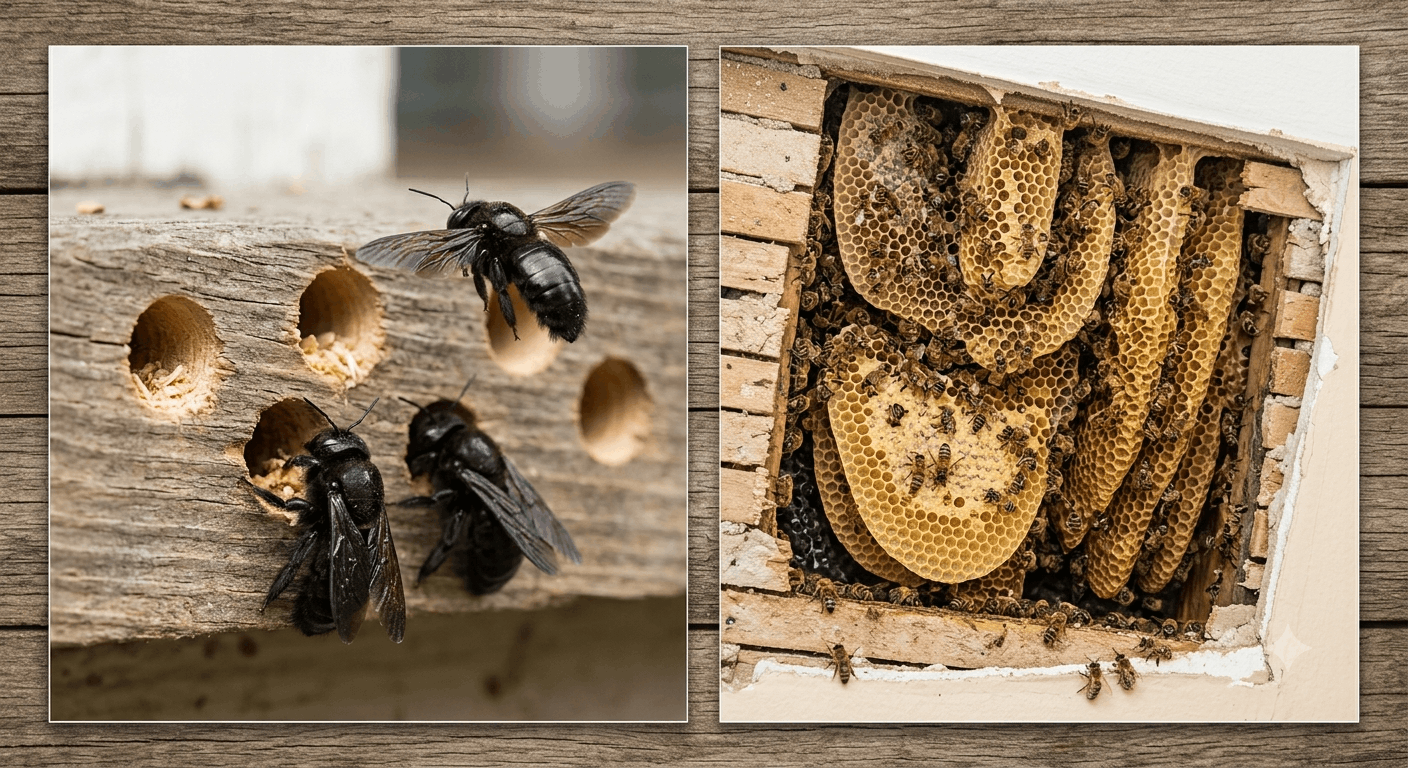
Carpenter bees silently tunnel through wooden structures over multiple seasons. By the time most homeowners notice the damage, repair costs have already climbed well beyond what early prevention would have cost. Regularly inspecting your home’s perimeter for smooth round holes or hovering bees is the most reliable way to catch carpenter bee activity early.
Honey bee colonies that settle inside wall voids grow quickly and produce large amounts of honeycomb. Even after the bees are removed, leftover honeycomb attracts other pests. Leaving a honey bee nest in place only gives the colony more time to grow and expand deeper into your structure, which is why complete nest removal by a trained professional is the only step that actually solves the problem. They are protected pollinators that play a critical role in Canada’s food supply and ecosystem. The Government of Canada actively works to protect pollinator health across the country through its pollinator protection initiatives, which is why correctly identifying the bee species near your home and taking appropriate action matters more than ever.
How to Prevent Different Types of Bees From Nesting Near Your Home
- Treat and paint all exposed wood around your home every spring to deter carpenter bees
- Inspect your exterior walls, roofline, and deck early in the season for holes or nest activity
- Never block an active nest entrance on your own, as this forces bees deeper into your structure
- Wear light coloured clothing outdoors and avoid strong floral perfumes during peak bee season
- Call a professional immediately if a nest appears inside a wall or near a high-traffic area
Do Not Wait for a Sting to Tell You There Is a Problem
Now you understand that the types of bees near your home range from gentle garden helpers to species that can silently destroy your wooden structures or send a family member to the hospital. The difference between a minor inconvenience and a serious problem is almost always how quickly you act.
Inspect your property early each season, seal exposed wood, and never attempt to handle an active nest on your own. When home remedies are not enough, trust the professionals to handle it correctly. 4K Pest Control is here to help you identify the species, locate the nest, and protect your home safely and effectively.
Frequently Asked Questions About Types of Bees
Q1. How Many Types of Bees Are There in Canada?
Canada is home to around 2,000 species of bees, including honey bees, bumble bees, carpenter bees, mason bees, leafcutter bees, and sweat bees. Most are solitary and harmless to people. Only a small number of species pose any real risk to homeowners or their properties.
Q2. Which Bee Is Most Dangerous Near a Home?
Among wood-damaging pests, carpenter bees are the biggest long-term threat due to their habit of boring deep into wooden structures. Honey bee colonies inside wall voids grow large and are costly to remove. Bumble bees defending a disturbed ground nest can deliver multiple stings, which makes them especially risky around young children and anyone with bee allergies.
Q3. How Do I Tell a Bee Apart From a Wasp?
Bees have broader, hairier bodies and rounder abdomens, while wasps have a narrow waist and smooth, elongated bodies. Bees are generally calmer and only sting when provoked. Wasps tend to be more aggressive and can sting repeatedly, even without much reason.
Q4. Should I Remove a Bee Nest Myself?
No, removing a bee nest without proper training and equipment carries serious risk. Disturbing a colony can trigger a mass defensive response very quickly. A licensed pest control professional can correctly identify the species and carry out safe removal or relocation without putting your family at risk.
Q5. Can Carpenter Bees Cause Serious Damage?
Yes, and the damage builds up quietly over several seasons. Carpenter bees bore precise circular tunnels into soft or untreated wood to lay their eggs. Over time, these tunnels weaken decks, fascia boards, window frames, and siding significantly. Treating exposed wood every spring is the most effective prevention.
Q6. Do All Bees Sting?
No. Bees usually only sting if you scare them by swatting them or disturbing their home. Male bees of most species cannot sting at all. Solitary species like mason bees and sweat bees are so gentle that they rarely sting, even when handled directly.