


You hear scratching inside your walls at night. You find strange droppings under the kitchen sink. You spot gnaw marks on a cereal box. These are not random signs. These are clear signals that rats have moved into your home without asking.
Rats do not stay quiet for long. A single pair of rats can produce hundreds of offspring within a year. The longer you wait, the bigger the problem grows. That is why knowing which rat exterminator method works, when to use it, and how it connects with other approaches can save you time, money, and a lot of stress.
This guide breaks down every major method that a professional rat exterminator uses today. We cover traps, poison bait stations, and exclusion in plain language. We also explain how these methods work together as one complete strategy, not as isolated fixes.
Why Rat Infestations Demand a Multi-Method Approach
No single rat exterminator method eliminates an infestation on its own. Here is why:
- Rats are highly intelligent and quickly learn to avoid traps, new scents, and familiar danger zones
- A rat that survives one attempt becomes harder to catch the next time
- Hidden populations living inside walls and burrows never come near surface traps at all
The three methods work as a connected system:
- Traps catch the rats actively moving through your living spaces
- Bait stations eliminate the hidden population that traps cannot reach
- Exclusion seals the building so no new rats move in after elimination
Skip any one layer, and you leave a gap. Rats will find it.
The Government of Canada’s pest management guidelines support this Integrated Pest Management (IPM) approach, recommending combined control strategies for results that actually last.
How to Know You Have a Rat Problem Before Calling an Exterminator
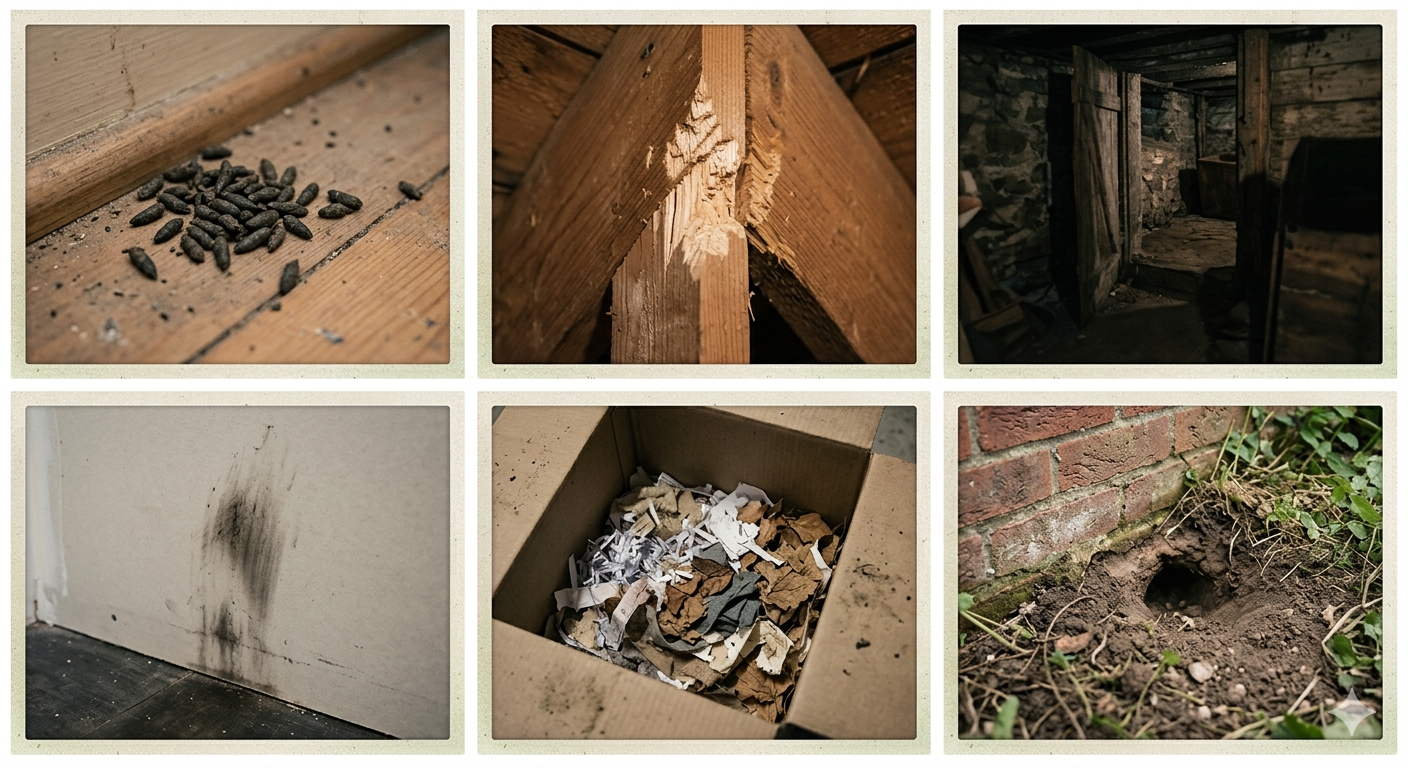
Rats are nocturnal, so you rarely see them directly. Watch for these signs instead:
Droppings
- Dark, shiny, capsule-shaped pellets near sinks, appliances, cabinets, and walls
- Norway rat droppings are rounded; roof rat droppings have pinched ends
- Both measure around 18 to 20 mm long
Gnaw Marks
- Chewed wood, plastic, insulation, or wiring throughout the home
- Fresh marks look pale; older marks turn dark
- Chewed wiring is a direct fire hazard
Sounds
- Scratching, scurrying, or squeaking inside walls, ceilings, or floors
- Most active between midnight and early morning
Greasy Rub Marks
- Dark smear marks along baseboards, pipes, and around holes
- Left by the grease and dirt on their fur as they travel set routes
Nesting Materials
- Piles of shredded fabric, paper, or insulation in hidden corners or wall voids
- Usually found behind appliances or in basement areas
Outdoor Burrows
- Smooth, worn holes roughly 5 to 7 cm wide near foundations, garden beds, or fencing
- Mostly dug by Norway rats
The earlier you catch these signs, the smaller and easier the infestation is to eliminate.
Not sure what the risk actually looks like once rats settle in? Our guide on living with rats in your home breaks down the health hazards and property damage rats cause the longer they stay.
Method One: Rat Traps Explained
Traps are usually the first tool a rat exterminator reaches for when handling an active indoor infestation. They provide immediate results and allow you to confirm that you are actually catching rats, not just guessing.
Types of Rat Traps
Snap traps. The snap trap is one of the oldest and most effective tools in pest control. A spring-loaded bar delivers a fast, lethal strike when the rat takes the bait. Modern snap traps are far more reliable and sensitive than older models. Professionals place them along walls, behind appliances, inside cabinets, and wherever droppings or activity are heaviest.
Bait matters a lot with snap traps. Peanut butter, chocolate, dried fruit, and small pieces of meat all work well. The bait needs to be placed deep enough on the trigger that the rat has to fully commit to grabbing it.
One important detail: rats are naturally cautious around new objects in their environment. A process called neophobia makes them hesitant to approach anything unfamiliar. Experienced exterminators often place unset traps for a few days first, allowing rats to get comfortable around them before activating the mechanism.
Live catch traps. Live traps capture rats without killing them. They are useful for property owners who prefer a humane approach, or in situations where the species needs to be identified before treatment. The downside is that you must check these traps daily and have a plan for releasing or humanely dispatching the animal well away from your property.
Electronic traps. These deliver a high-voltage shock that kills the rat instantly. They are extremely effective, low-maintenance, and easy to clean and reset. They work particularly well in kitchen areas and spaces where visible evidence of a dead rat would be problematic.
Glue boards trap rats on a sticky surface. They are useful for monitoring activity levels and detecting exactly where rats travel, but they are not considered the most effective or humane primary elimination tool. Rats can sometimes free themselves, and in shared or commercial spaces, non-target animals can become stuck as well.
Where Traps Work Best
Traps are most effective when placed:
- Along the base of the walls, where rats naturally travel
- Behind kitchen appliances such as fridges, stoves, and dishwashers
- Inside the lower kitchen and bathroom cabinets
- In attic spaces along beams and rafters
- In basement corners and along pipe runs
- Near confirmed burrow openings outside
Spacing matters. One or two traps will not catch a significant population. A professional rat exterminator will deploy multiple traps across all active zones and check them regularly.
Method Two: Rodenticide Bait Stations Explained
While traps catch rats you can see and access, poison bait stations target the larger hidden population living deep inside walls, under floors, and in outdoor burrow systems.
How Rodenticide Works
Modern rodenticides used by professional rat exterminators are almost always anticoagulants. These compounds prevent blood from clotting normally. A rat that feeds on the bait dies several days later, usually outside the structure, which reduces the chance of dead rats decomposing inside walls.
Anticoagulant rodenticides come in two main forms: first-generation and second-generation.
First-generation products require multiple feedings before they become lethal. Second-generation products are more potent and work after a single feeding. Because of the higher potency of second-generation products, their use is regulated in Canada. According to Health Canada’s Pest Management Regulatory Agency, certain second-generation anticoagulants are restricted to licensed pest control professionals only, which is one very good reason to hire a certified exterminator rather than attempting to self-treat.
Tamper-Resistant Bait Stations
Poison bait is never left loose or open in a professional treatment. It always gets secured inside tamper-resistant bait stations. These are thick, enclosed plastic containers with entry points sized specifically for rodents. Children and most pets cannot access the bait inside.
Bait stations serve multiple purposes:
- They save the bait from moisture and contamination
- They make the bait feel safe and sheltered to the rat, which increases feeding
- They prevent accidental poisoning of children, pets, and non-target wildlife
- They allow technicians to monitor consumption and adjust placements as needed
Professional exterminators place bait stations both inside and outside the property. Interior stations go in low-activity transition zones like basements and utility rooms. Exterior stations go along the building perimeter, near burrow openings, and along fence lines.
Why DIY Bait Often Fails
Consumer-grade rodenticide products from hardware stores use weaker active ingredients in lower quantities. They often come in unsecured packaging that children and pets can open. Most urban rats in Canada have developed resistance to older active ingredients like warfarin. A professional exterminator uses regulated, higher-quality products placed strategically and in sufficient quantities to eliminate the population, not just reduce it temporarily.
Method Three : Exclusion: The Foundation of Permanent Rat Control
Traps and poison bait stations can eliminate the rats currently in your home. But if you do not seal the building, new rats will simply move in to fill the vacancy. Exclusion is the step that makes your results last.
What Exclusion Involves
Exclusion means physically blocking every entry point that rats could use to access your building. A rat exterminator trained in exclusion work will inspect your entire property systematically, checking for:
Foundation gaps and cracks. Rats can squeeze through openings as small as 12 mm in diameter. Any crack in your foundation, any gap around a pipe or conduit entry, and any space between building materials at ground level becomes a potential entry point.
Roof and attic access points. Roof rats are skilled climbers. They use tree branches, utility lines, and rough wall surfaces to reach your roofline. Loose soffits, missing fascia boards, gaps around chimney flashing, and deteriorated roof vents all provide access.
Door and window gaps, gaps under doors, missing door sweeps, damaged weatherstripping, and poorly fitting screen doors all allow rat entry. These are among the most commonly overlooked entry points.
Plumbing and utility penetrations. Every pipe, wire, cable, and conduit that passes through your foundation or exterior walls creates a potential gap. Rats follow pipes from sewer systems directly into buildings. Rats can also swim through partially filled drain pipes.
Materials Used in Exclusion Work
Different gaps require different materials:
- Steel wool and hardware cloth: Rats cannot chew through tightly packed steel wool or steel mesh. These materials fill gaps and openings while still allowing for air movement where needed.
- Expanding foam: Used to fill smaller cracks and gaps around pipes. Note that foam alone is not enough, as rats will chew through it. Foam works best as a secondary filler behind steel mesh.
- Metal flashing: Installed along rooflines, around chimney bases, and at the base of wood siding to prevent rats from chewing their way in.
- Door sweeps and brush seals: Installed at the base of all exterior doors to eliminate the gap that allows rodent entry.
- Wire mesh vent covers: Replaced over deteriorated or missing vent covers on soffits, crawl spaces, and foundation vents.
Why Exclusion Must Come Before or Alongside Elimination
Here is an important sequence issue that many homeowners overlook. If you seal all the entry points before eliminating the rats already inside, you trap them in your home with no food source, which can drive them to chew through new areas in desperation. The correct professional approach seals most entry points while leaving one or two escape routes monitored with traps or bait stations, then seals those final points once the population is eliminated.
This connected approach is exactly why professional rat exterminators treat exclusion as part of a complete program, not a separate project you do months later.
How Traps, Poison, and Exclusion Work Together as One System
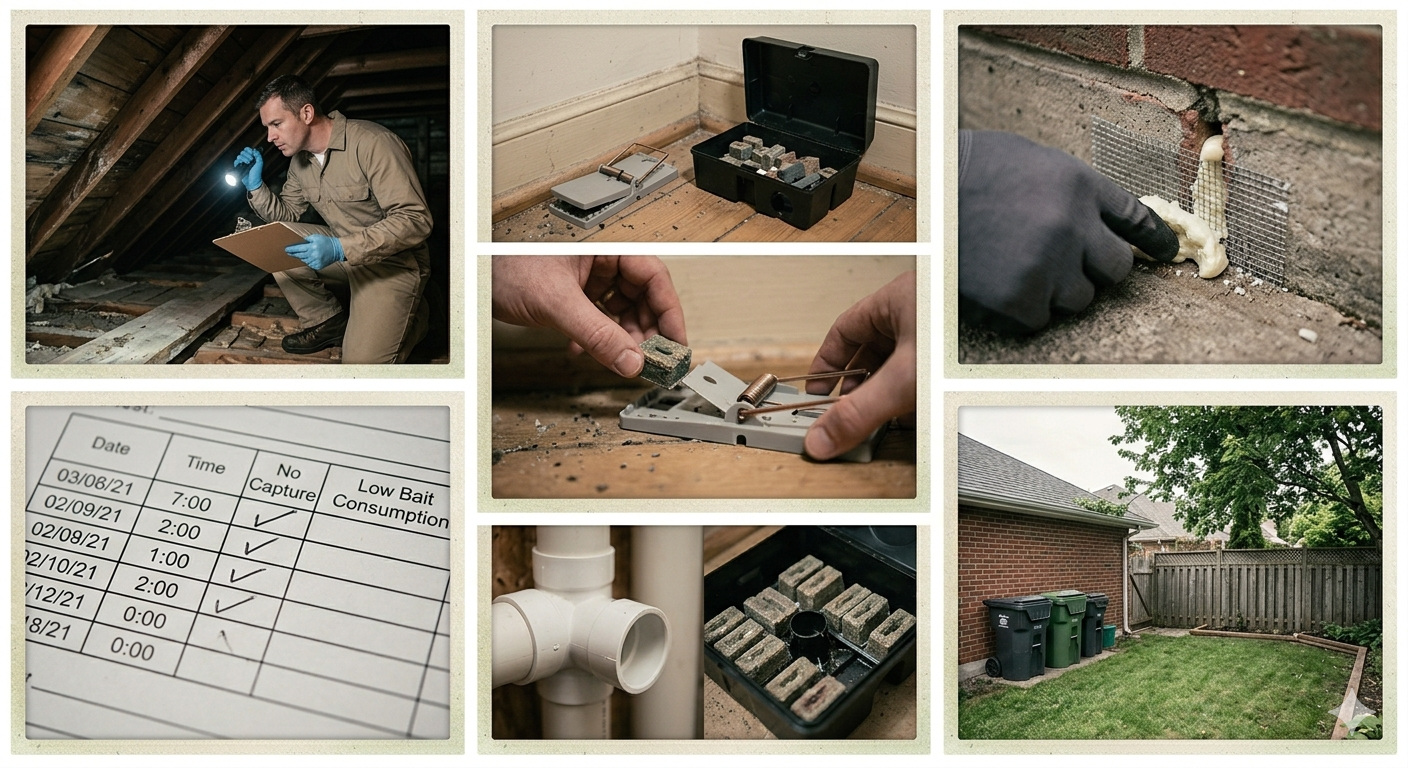
Now that you understand each method individually, it becomes clear why they form a connected sequence rather than three separate options.
Think of it this way:
Step 1: Inspect. A professional rat exterminator inspects the full property to understand the species, population size, active zones, entry points, and conditions attracting rats to the property.
Step 2: Eliminate Traps and bait stations go into active zones simultaneously. Snap traps catch rats in accessible, high-traffic areas. Bait stations target the larger hidden population in wall voids, attic spaces, and outdoor burrow systems. This phase reduces the population quickly.
Step 3: Exclude. While elimination is underway, exclusion work begins. Entry points get sealed systematically, working from the least active zones inward. This prevents new rats from entering and forces remaining rats toward the traps and bait stations.
Step 4: Monitor. Ongoing monitoring confirms that the infestation is fully resolved. Bait station consumption levels drop. Traps stop catching. Droppings stop appearing in previously active zones. A follow-up inspection confirms that no new activity has started.
Step 5: Prevent Good exclusion work, combined with sanitation recommendations, keeps your property protected long-term. Removing food attractants, securing compost and garbage, clearing yard debris, and trimming tree branches away from the roofline all reduce the chances of re-infestation.
Stop Waiting: Take Control of Your Home Today.
Rats move fast. A small problem becomes a large infestation within weeks. The methods covered in this guide, traps, poison bait stations, and exclusion, work best when used together as a connected system under the supervision of a trained professional.
If you spot the signs, do not delay. The longer a rat population goes untreated, the more damage it causes, the more health risk it creates, and the harder it becomes to eliminate completely.
4K Pest Control brings all three methods together in a structured, professional treatment plan designed for Canadian homes and businesses. Our rat exterminator technicians inspect every corner of your property, deploy traps and bait stations in the right locations, and seal every entry point rats could use. We do not just reduce your rat problem. We eliminate it.
Contact 4K Pest Control today at 4kpestcontrol.ca to schedule your inspection and take the first step toward a fully protected, rat-free property.
Frequently Asked Questions About Rat Exterminator Methods
Q1. How long does it take for a rat exterminator to eliminate a full infestation?
Most professional treatments begin showing results within 3 to 5 days as bait consumption starts and traps begin catching rats. A moderate infestation typically resolves fully within 2 to 4 weeks, depending on population size, building complexity, and how thoroughly exclusion work was completed alongside elimination.
Q2. Is rat poison safe to use in a home with children and pets?
Professional rat exterminators use tamper-resistant bait stations that children and most pets cannot open. The bait itself is placed deep inside the unit and never left loose. However, you should always tell your exterminator about any pets, especially dogs that dig, so placements can be adjusted to locations pets cannot reach.
Q3. Will dead rats create a smell inside my walls after treatment?
Modern professional-grade rodenticides often contain a desiccant that accelerates drying of the body, significantly reducing odour. Bait stations also drive rats outdoors in search of water before they die, so the majority of deaths occur outside the structure rather than inside the walls.
Q4. Do ultrasonic repellers actually work to keep rats away?
There is no reliable scientific evidence that ultrasonic devices prevent or eliminate rat infestations. Rats quickly habituate to sound-based deterrents and continue normal activity within days. Exclusion work, traps, and bait stations remain the only proven rat exterminator methods with consistent results.
Q5. How do I know all the entry points have been found and sealed?
A thorough inspection by an experienced rat exterminator covers the entire foundation perimeter, roof line, all pipes and utility penetrations, and all door and window gaps. Experienced technicians know exactly where to look based on species behaviour and building construction. Follow-up monitoring confirms whether a new entry has occurred after exclusion work.
Q6. Can rats come back after a professional treatment?
Rats can return if exclusion work was incomplete or if new gaps develop over time. Good maintenance habits, including sealing gaps promptly, securing garbage and compost, removing yard debris, and trimming vegetation away from the building, significantly reduce the risk of re-infestation after professional treatment is complete.